Sci-Fi Labs · Essay
The Golden Handcuffs: How Tesla Sold You Surveillance as Safety
Your Tesla is already recording you. Not the Robotaxi — your car. Right now.
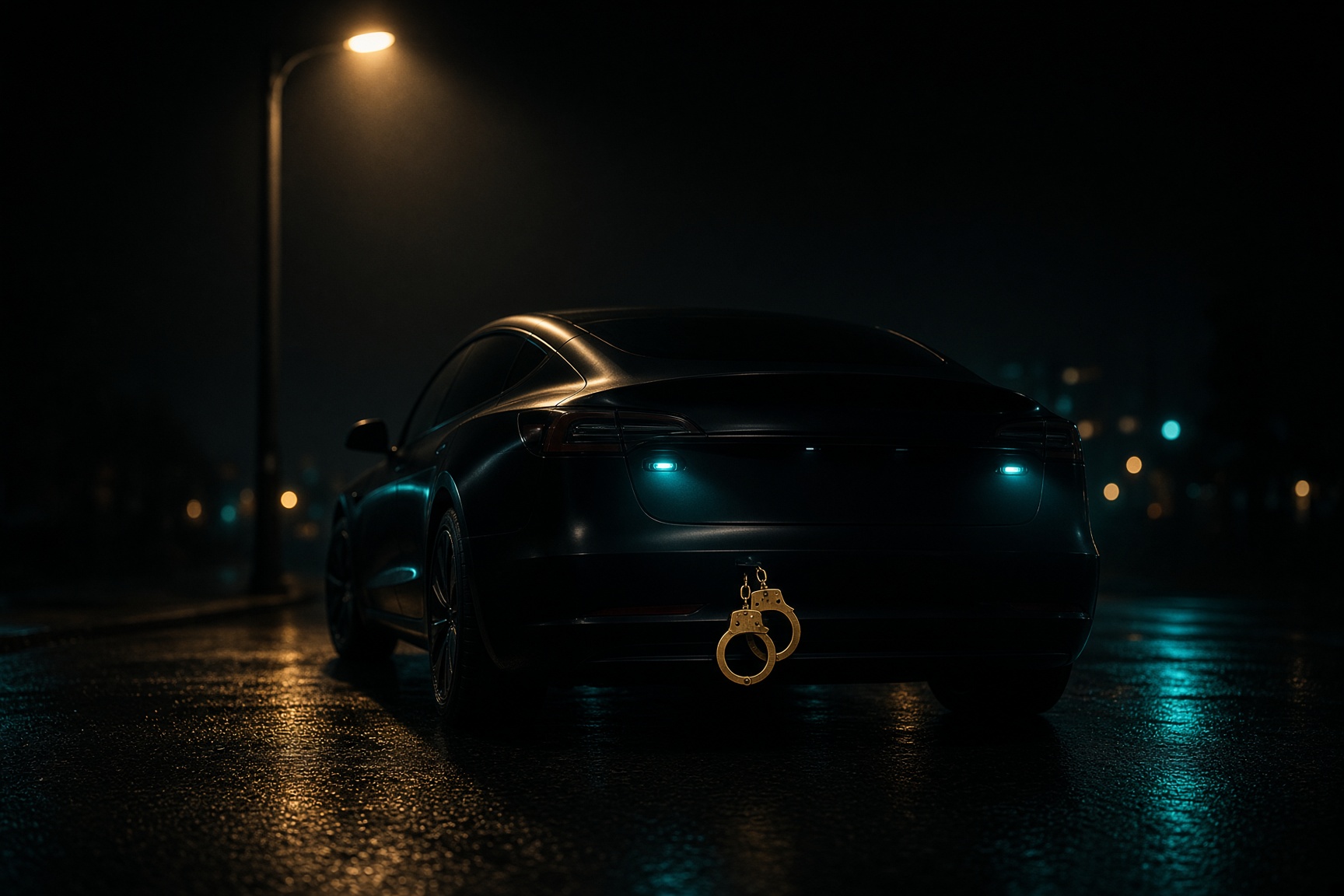
The moment someone walks near it, Sentry Mode wakes up, the cameras start rolling, and the mics start listening. Tesla calls it security. It's the same fear-based playbook as Flock cameras: scare you first, then hand you the tool that watches you.
What they don't lead with
Current Teslas run eight exterior cameras plus a cabin camera. On Hardware 4, the front sensors are about five megapixels with a hundred twenty decibel dynamic range — they see into dark tunnels while headlights are blazing. The narrow front lens reaches two hundred fifty meters. The wide one covers a hundred twenty degrees. Side and rear cameras fill in the rest for full three-sixty coverage. Newer cars added a ninth low front-bumper camera.
Sentry Mode and Dashcam record up to six angles at once — front, rear, both repeaters, both B-pillars — in a rolling buffer that can hold a full day of footage. The mics are tuned for voice commands and calls, so they pick up clear speech a few feet out. The Cybercab adds external mics in the B-pillars specifically so cops can talk to Tesla support without opening a door. Tesla doesn't publish exact sensitivity numbers, but the capability is there.
And the scale is staggering. Tesla just crossed its ten-millionth vehicle in late July — roughly nine to ten million on the road worldwide. Every one of them is a rolling sensor. The fleet data is the actual product, and the "it's just for self-driving" framing is the cover story.
No wheel, no pedals
Then the Robotaxi arrived, and everyone got excited. Four hundred twenty registered in Texas as of this week, forty-five of them the new Cybercabs.
That is the reroute-to-jail. You asked to go to a street, a protest, a friend's house — and the software sends you to a police station instead. You cannot grab a wheel. You cannot pull over. The car driving you is also the camera that will be used against you.
Elon is painting this as the golden era of cars, and the cars are genuinely beautiful. Yesterday, quoting a Cybercab clip:
But it's golden handcuffs for comfort. We're trading freedom for convenience, and the cameras, mics, and fleet data are the price.
Your Tuesday
Every trip becomes a timestamped record, and the state never has to ask permission because the data already exists.
Picture this: a protest gets announced, and the city quietly geofences the area. You pin the corner. The car takes you somewhere else. You never get there. No arrest, no confrontation, just a car that won't take you. That's the police state that never has to show up.
The next version does show up, and you are already in the back seat. The car doesn't block you. It delivers you. Your posts, your past routes, the Sentry footage — cross-referenced in seconds. You asked it to take you to that street, so the system decides you were going there, so you're already guilty, and the destination changes. No warrant for the ride. No trial in the back seat. You asked for a corner. You arrive at the police station. The officer says we have you on camera — and the camera is the car you rode in. You can't argue with the evidence because you were sitting in it. There will still be a lawyer. There will still be a court. The case walks in already made, by the vehicle that drove you there.
Or the insurance company that knows you drove past a bar at two a.m. and nudges your premium up. Or the ex who pulls your Sentry footage to see who visited your house. The freedom you lose isn't dramatic — it's the freedom to move without being legible, to be anonymous in public, to have a private life that isn't a dataset someone else owns.
The slow stuff is where it gets ugly. Your Robotaxi logs every destination, so a lender can see you visited a bankruptcy attorney and quietly deny the loan. A divorce lawyer subpoenas your Sentry footage to prove you were somewhere you said you weren't. Your employer buys fleet data and knows you stopped at a union meeting on your lunch break.
Then the infrastructure itself becomes the lever. A city decides certain neighborhoods get slower routes or higher fares — not a law, just an algorithm. You can't vote it out because there's no vote. The software update just ships. And the generational lock-in: kids who never learn to drive can't even rent a car in a pinch. The opt-out disappears because the skill disappears.
It's just for safety
The scary part is none of it requires a villain. It just requires everyone to keep saying "it's just for safety."
So here's the question. If you pin a corner and the car takes you to a police station — who do you argue with?