Sci-Fi Labs · Essay
Utility vs Personal AI
OpenClaw proved an agent could do things on your computer. It also tried to be a companion. The same agent can rarely be both. That split is why Knowledge Graph is built the way it is.
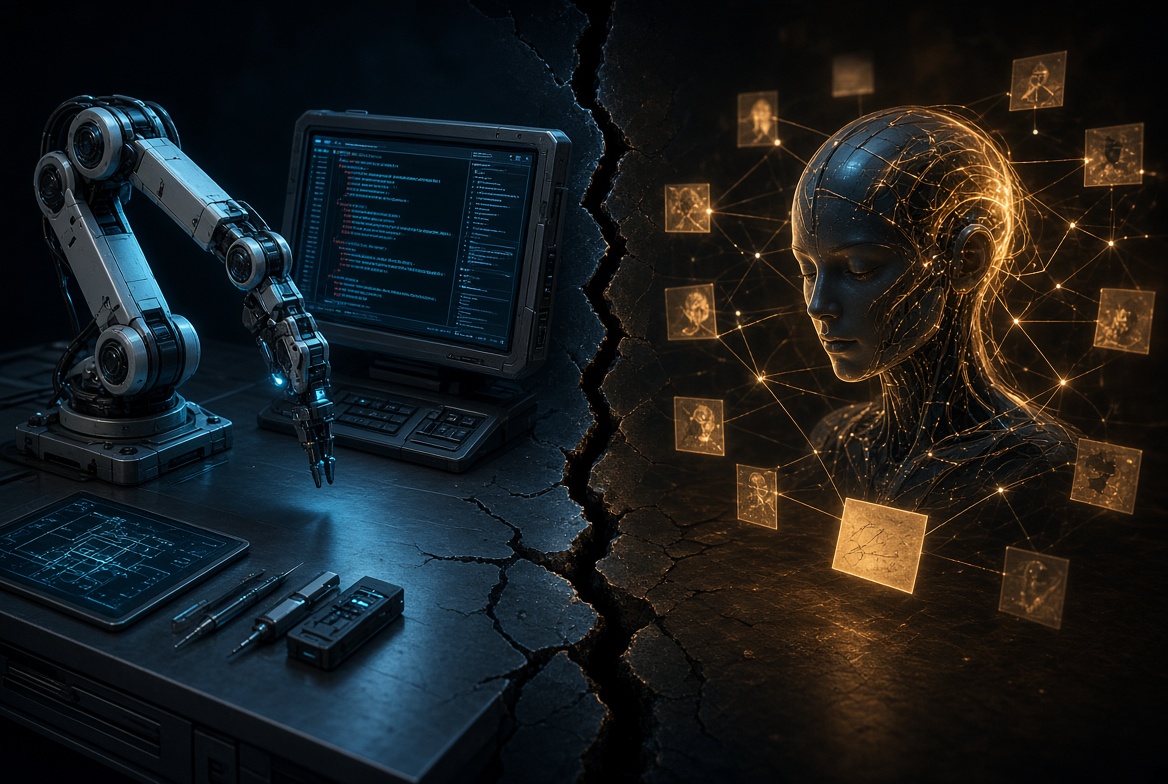
The first wave of agent projects were exciting because they did something. OpenClaw was the first publicly viral agent that could reach into your filesystem, run a command, open a browser, and come back with a result. That is a real leap. Before it, “AI assistant” meant a chat window that wrote you a poem. After it, the bar moved: can the agent finish the task end to end on the machine in front of you?
That bar is a utility bar. It asks the agent to be a tool. A competent, scriptable one. It does not ask the agent to know you.
The companion instinct
Almost immediately, the same projects reached for a second register. OpenClaw shipped a Soul.md, a markdown file that gave the agent a personality, a backstory, a voice. Hermes and the others followed with their own variants. The pitch was appealing: not just a tool that executes, but a presence that remembers you, has opinions, and is pleasant to talk to.
This is where the crack appears. A personality layer is cheap to add. A memory layer is not. Soul.md can make the agent charming in one conversation. It cannot make the agent remember that your sister is getting married in June, that you hate getting calendar reminders after 9pm, or that the “Dave” you mentioned yesterday is the Dave you have been arguing with for a week. Those require a durable, structured, queryable model of your life. That model has to survive across sessions, across tasks, and across the agent being asked to do something completely unrelated.
Two agents, one seat
Utility and personal AI are not the same product wearing different skins. They are two different agents, with different architectures, different success metrics, and different failure modes. Asking one to be both is where most of the disappointment comes from.

| Utility agent | Personal memory | |
|---|---|---|
| Job | Finish the task | Hold the context |
| Success | Correct, fast, done | Remembers, correlates, anticipates |
| Failure mode | Does the wrong thing loudly | Forgets quietly |
| Memory | Scratchpad, ephemeral | Durable graph, long horizon |
| Surface | Command, task pane, REPL | Conversation, canvas, timeline |
| Privacy exposure | Low. Your code, your shell. | High. Your life, your relationships. |
Notice the last row. A utility agent reading your filesystem to find what is eating your disk is touching your machine, not your life. A personal agent that knows your friends, your appointments, and your moods is touching your life. The moment you ask a utility agent to also be personal, to hold context across days, to weave your relationships into its reasoning, you have handed it the highest-value data you generate, and you have done it inside a product whose first job is to go execute commands. That is a strange place to store your privacy.
Why the merge keeps failing
Every few months a new agent launches claiming to be both. The pattern is predictable. The utility story works on day one. It can book the flight. It can fill the spreadsheet. The personality story works on day two. It has a name, a vibe, a Soul.md. By day twenty you notice the agent still does not remember the flight it booked, the spreadsheet it filled, or the preference you stated three conversations ago. The utility was real. The personal layer was set dressing.
The reason is structural, not laziness. A utility agent optimizes for completing the current task. Every byte spent on durable personal context is a byte not spent on the task graph, the tool inventory, the planner. A personal agent optimizes for continuity across time. Every byte spent on the current task is a byte that could have deepened the model of you. These are not the same loss function. Jamming them into one process produces an agent that is mediocre at both and excellent at neither.
What Knowledge Graph bets on instead
Knowledge Graph starts from the personal side. The first thing it builds is the durable memory: a spatial graph of your photos, notes, voice, and time. The utility layer, the agent that can act on the machine, is a separate concern that reads from and writes to that graph. It is not the same process. It does not own the memory. The memory is the product. The utility agent is a client of it.
This is why the series spends so much energy on the 16 GB constraint. 16 GB is the machine most people actually have. A personal memory that only runs in the cloud is not personal. It is a profile a company holds about you with a chat window in front. The constraint that the whole thing fit on the laptop you already own is what keeps the personal agent personal. Part 1 of the series is the canvas and the stack. The memory problem, and why it is harder than the utility problem, is the spine of the whole thing.
Once you decide the personal agent has to hold your life, the question of where that life lives becomes load-bearing. The moment you wire in a calendar API, a contacts API, a model API, you have handed the personal layer to a different company for each wire. That is its own essay: Who has your data?.
The split, on this machine
This is not a hypothetical. The boundary is clean enough to state in one sentence.
On the utility side this laptop uses opencode, backed by GLM-5.2 Cloud. It is incredible at what it does. It gets the job done. It built and maintains every app shipped here: this site, this blog, and the Sci-Fi Labs apps. It reads the codebase, runs the commands, edits the files, and ships. It never gets a single piece of personal data. It does not need to know the person. It needs to finish the task.
On the personal side, the Knowledge Graph runs on a local model. That model holds everything. Photos, conversations, long-term memory, the parts of a life that make it personal. It never leaves the laptop. Every secret, every relationship, every private detail stays on a machine under this desk. The utility agent never sees it. The personal agent never reaches out to the cloud to reason about it. The two sides do not share a process, a context window, or a server.
That is the whole point. The utility agent is sharp, fast, cloud-backed, and disposable. Swap the model tomorrow and nothing personal is lost. The personal agent is slow, local, and irreplaceable. That is exactly why it never touches a network it does not have to. The essay argues the split is structural. The setup is the proof.
On this laptop the model is Bonsai. Whisper hears. Kokoro JS speaks. Where is Paul? turns a travel record into a globe and a timeline without parking the raw material on a third-party server. The published sites are demos. The product is the copy that runs on your machine. Offline is the proof. Memory you own, models you run.