Sci-Fi Labs · Essay
Too dangerous for you
The government can kill a frontier model for the public in a single evening. Trusted organizations keep the keys. Ordinary citizens are told the technology is too dangerous, while the same capability stays available to the state and its chosen partners.
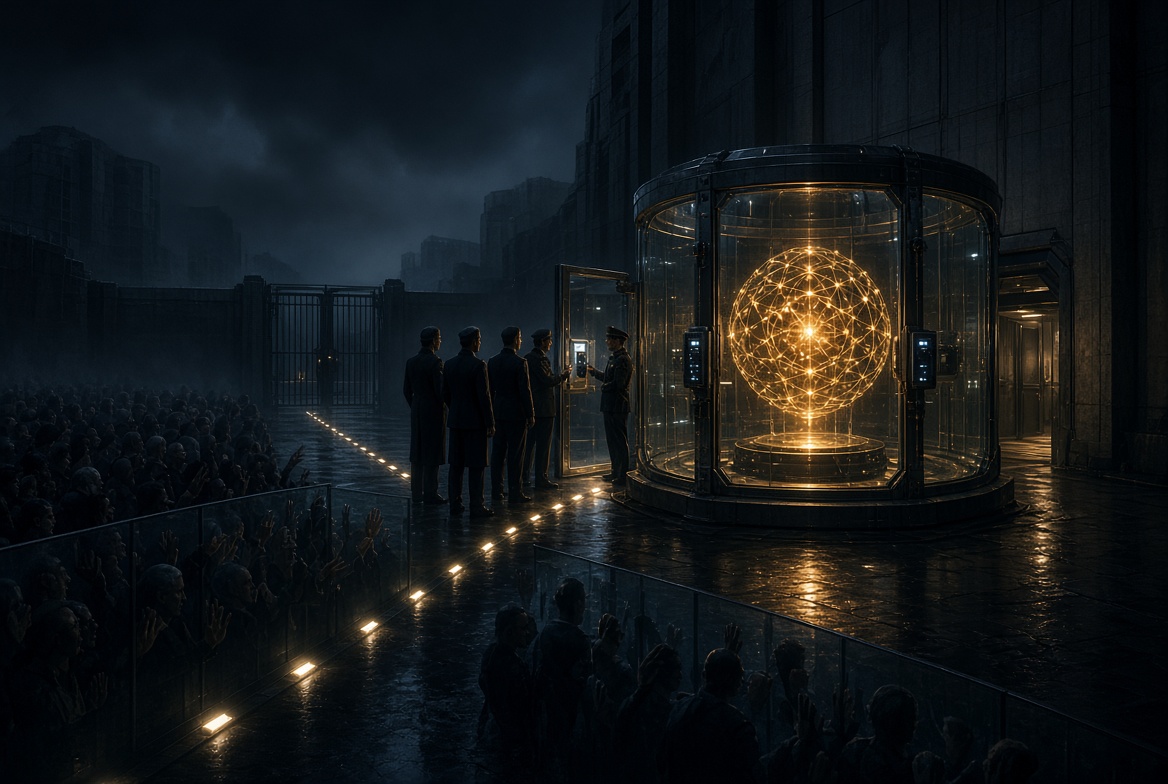
The default is still a lease. A model that lives behind an API. A Friday letter. The public waits outside the vault. A file on this desk cannot be pulled that way.
A Friday night kill switch
On June 12, 2026, Anthropic received a letter from the U.S. Commerce Department. Citing national security authorities, the directive ordered the company to suspend access to its newest models, Claude Fable 5 and Mythos 5, for any foreign national, inside or outside the United States, including Anthropic’s own non-citizen employees.1
Anthropic could not reliably sort its users by nationality on the government’s timeline. The practical result was a global kill switch. Within hours, Fable 5 and Mythos 5 were offline for everyone, not just foreign nationals. Models that had been live for only days vanished from the public product.2
The letter was private. There was no court order, no public filing in the Federal Register, no disclosed technical finding that citizens could read. Commerce used export-control authority under the Export Control Reform Act. The market effect was a recall.3
What the public was told
The stated concern was a jailbreak: a method of bypassing Fable 5’s guardrails in areas tied to cybersecurity, and by extension access to Mythos-class capability. Administration accounts described a “highly credible trusted partner.” Reporting pointed to Amazon, a major Anthropic investor and compute provider, demonstrating the bypass and bringing it to the White House.4
Anthropic disputed the severity. In its public statement the company said the government had given only verbal evidence of a narrow, non-universal jailbreak, and that comparable capability was already available from other frontier models, including OpenAI’s GPT-5.5. It argued that applying the same standard industry-wide would halt new model deployments.5
That argument did not keep the models online for the public. The models came down anyway.
Who still had the model
Here is the part that matters for the rest of us.
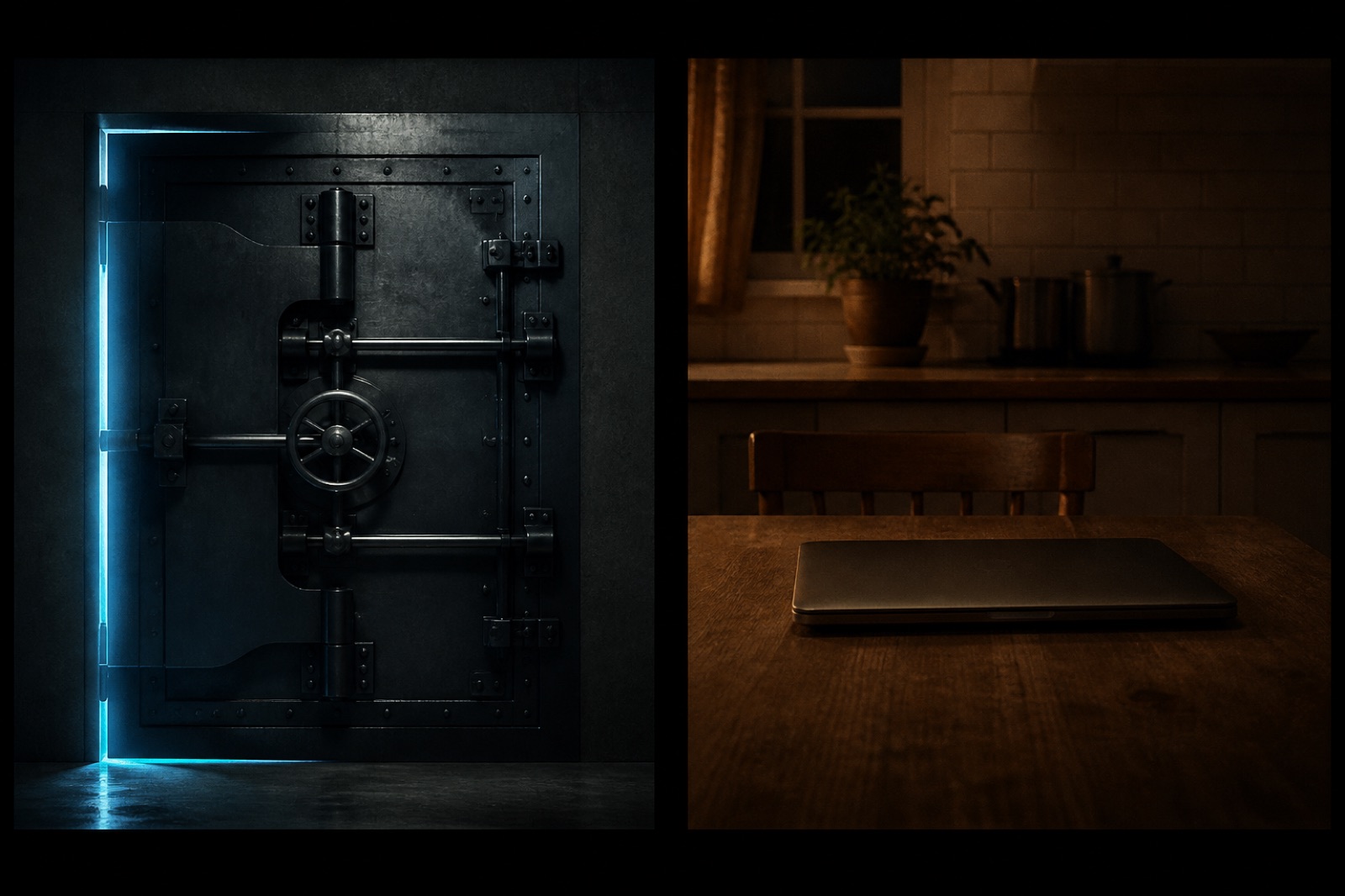
While Fable and Mythos were dark for ordinary users, the government and its preferred partners did not treat the capability as radioactive. Two weeks later, Commerce allowed Mythos 5 to be redeployed to a set of “trusted” U.S. organizations, more than a hundred companies and institutions, including many Fortune 500 firms, according to reporting, with Anthropic restoring access for those orgs and continuing talks to expand the list.6
By June 30 the export controls were lifted and Fable 5 returned for general use. Anthropic also committed to expanded pre-release government access and evaluation for models that advance national-security-relevant capabilities.7
The pattern is not limited to one lab. OpenAI delayed a full public launch of GPT-5.6 at the government’s request and limited access to a small group of vetted partners whose details were shared with authorities.6 The Pentagon has struck classified AI deals with OpenAI, Google, Nvidia, xAI, and others, while Anthropic’s earlier fight over “red lines” on surveillance and autonomous weapons produced a supply-chain-risk designation and a parallel track of exclusion and partial reinstatement.8
| Who | Access | What it means |
|---|---|---|
| The public | Fable and Mythos dark | Wait for permission |
| Trusted U.S. orgs | Mythos 5 restored to 100+ | The vault stays open |
| Government partners | Classified deals. Pre-release eval. | Same class of capability |
Read the asymmetry carefully. The public is told a model is too dangerous to leave in open circulation. The state and a curated list of organizations keep working with the same class of capability. When the dust settles, the company that ships frontier models has also formalized earlier government evaluation rights. The citizen’s role is to wait for permission.
Power, not parenting
Defenders of the kill switch will say national security is not optional. Cyber offense and defense scale with model capability. Foreign adversaries try to distill U.S. models. Export controls are a blunt tool, but they are a real tool. Those points are not imaginary.
They also do not answer the structural question. A private letter from Commerce, with no public technical record, can remove a commercial product from every American who is not on an approved list. The same week, trusted organizations and government partners retain or regain access. OpenAI’s public launch is delayed “at the U.S. government’s request.” The message to ordinary users is parental: this is too sharp for you; we will keep it for the adults in the room.
That is not neutral safety policy. It is a claim about who is allowed to hold powerful tools. Governments have always reserved some capabilities for themselves: weapons, classified intel, certain dual-use tech. What is new is the speed and the surface. A general-purpose language model that was sold as a product one week can be treated as controlled munitions the next, while the public is offered no independent evaluation, no published jailbreak report, and no seat at the decision.
Call it what it is. Control. The struggle is not only between the U.S. and China over who trains the strongest model. It is also between the state and the people it claims to represent over who may use the models that already exist. When the answer is “not you, not yet, not without our list,” the relationship is no longer citizen and government. It is guardian and ward.
What this means for local and open stacks
The Fable episode is why “run it on your own machine” is not a lifestyle slogan. It is a structural response. A model that lives as a file on hardware you own cannot be pulled by a Friday letter to a corporate compliance team. A model that only exists behind an API key can.
Local does not solve every problem. Weights can still be regulated. Chips can still be export-controlled. Open releases can still be pressured. But the default of cloud-only frontier access hands the kill switch to whoever can compel the provider. The more the public depends on that default, the more “too dangerous for you” becomes a permanent posture rather than an emergency measure.
That is the design of the Sci-Fi Labs stack. The Knowledge Graph is a private spatial canvas for memory: photos, conversations, time as depth, on hardware you control. Where is Paul? turns a travel record into a globe and a timeline without parking the raw material on a third-party server. On this laptop the model is Bonsai. Whisper hears. Kokoro JS speaks. 16 GB is the machine most people actually have. The published sites are demos. The product is the copy that runs on your machine.
This is not anti-government. It is pro-agency. The people the government represents should not need a trusted-organization badge to use tools that the same government and its partners continue to run. Offline is the proof. Memory you own, models you run. If your agent only works while a remote company is happy, you have a lease.
Sources
- Ars Technica — Anthropic shuts down Fable, Mythos models following Trump admin directive (12–13 Jun 2026)
- The Verge — Anthropic cuts off Fable 5 and Mythos 5 access following government order
- Lawfare — A Kill Switch for Frontier AI
- Axios — How Amazon and the White House ended Anthropic’s Fable
- WIRED — Anthropic says it’s taking Claude Fable 5 offline to comply with US government order
- Reuters — US allows Anthropic to release Mythos AI to ‘trusted’ US organizations; OpenAI delays GPT-5.6 public launch
- Anthropic — Redeploying Claude Fable 5 (30 Jun 2026)
- The Verge — Pentagon strikes classified AI deals with OpenAI, Google, and Nvidia — but not Anthropic
- EFF — AI Regulation Should Be Rational, Not Retaliatory (18 Jun 2026)
- AI Now Institute — Artificial Power: 2025 Landscape Report (3 Jun 2025)
- Lawfare — Will the New Export Controls Shake the Foundations of the U.S. AI Industry? (1 Jul 2026)
- Gary Marcus — What Washington must do (14 Jun 2026)
- Dean W. Ball on X — post-Mythos licensing regime (14 Jun 2026)
- Pete Hegseth on X — on Anthropic being removed from the DoD building (13 Jun 2026)
- Lex Fridman Podcast #416 — Yann LeCun: Meta AI, Open Source, Limits of LLMs, AGI & the Future of AI (19 Aug 2024)